

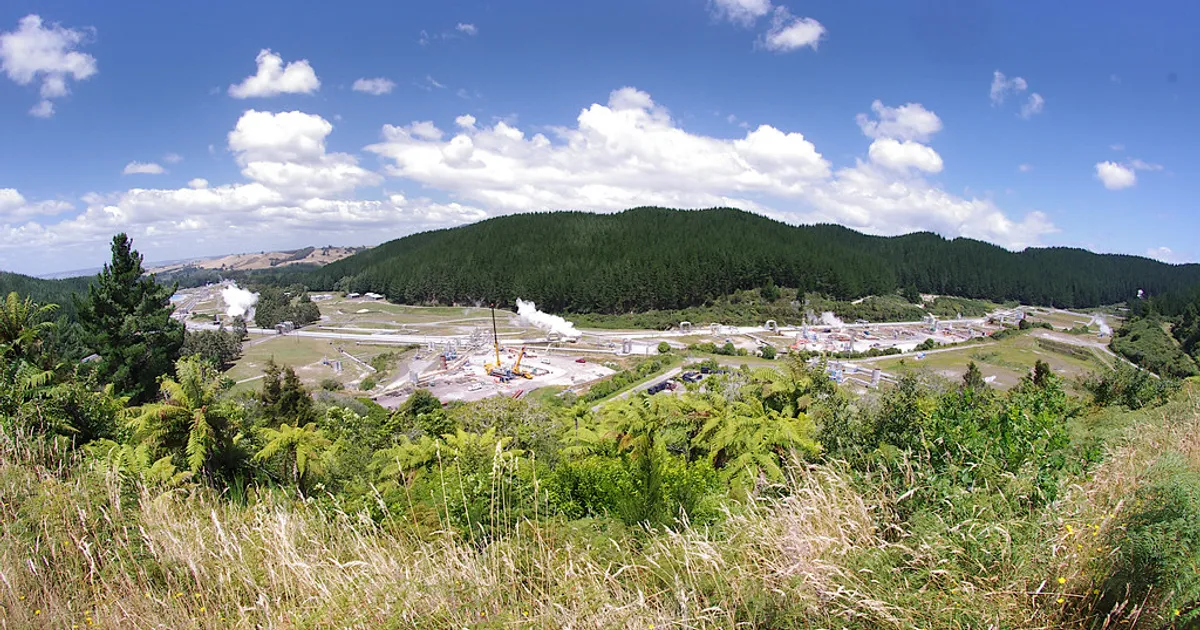
The grid already depends on geothermal more than most people realise
Resources Minister Shane Jones has committed $50 million from the Regional Infrastructure Fund to a geothermal development fund, alongside a draft strategy called ‘From the Ground Up’ that targets doubling geothermal’s share of electricity generation by 2040. A separate $60 million has been earmarked for supercritical geothermal R&D, with $5 million already drawn down for design work on the first deep exploratory wells in the Taupō Volcanic Zone.
The timing is not accidental. In the June 2025 quarter, hydro generation fell 6.8%. It was geothermal that filled the gap, with new capacity at Tauhara and Te Huka pushing output to a record 2,471 GWh, enough to power every household in the Waikato, Bay of Plenty, and Gisborne regions for a full year. The renewable share held at 84.1% despite the hydro shortfall. Without geothermal, coal and gas would have picked up the slack.
This is the point the energy transition conversation keeps glossing over. Wind and solar are growing fast, with wind up 17.6% and solar up 48.7% in the same quarter, but neither provides firm baseload. EECA CEO Dr Marcos Pelenur puts it plainly: geothermal plants deliver capacity factors above 90%, compared to roughly 40% for wind. A food processor, data centre, or paper mill cannot schedule production around the weather.
Demand is coming and intermittent supply cannot meet it
New Zealand’s electricity demand is projected to rise 68% over the next 25 years, driven by transport electrification, industrial fuel switching, and data centre growth. The existing fleet of 17 geothermal plants across eight fields delivers 1,207 MW, contributing 19.9% of annual generation. That share needs to grow substantially if the grid is going to absorb the coming demand without reverting to fossil fuels.
Jones is leaning on historical precedent. As he told Newstalk ZB, ‘The Crown stepped up to the plate in the 1950s, did an enormous amount of drilling, not always successful, but a number of those drill holes have turned into major electricity suppliers.’ Wairakei opened in 1958 as the world’s second geothermal power station. Crown-funded exploration created the resource base the private sector later commercialised. The playbook is not new.
Supercritical drilling is the real gamble, and probably the right one
The $60 million supercritical R&D commitment is the more consequential piece. Supercritical geothermal targets rocks between 375°C and 500°C, reached by drilling 4-6 km deep. Water at those temperatures carries three to seven times more energy than conventional geothermal steam. GNS Science estimates the central North Island holds about 3,500 MW of supercritical resource, with energy consultancy Castalia pegging the commercially viable portion at 1,300 to 2,000 MW from 2037.
New Zealand has a geological advantage. Supercritical resources sit at unusually shallow depths here compared to other geothermal countries, with highly permeable rock enabling easier fluid flow. Tim Groser, chair of the Supercritical Geothermal Project board, calls it ‘as close to what I’d call a silver bullet in terms of what is really required on climate change.’ The Rotokawa Geothermal Reservoir near Taupō has been chosen as the preferred first drill site.
Academic analyst David Dempsey raises a fair question in The Conversation: the private sector has invested $2 billion in geothermal over the past two decades, so why does the government need to step in? The answer is that supercritical geothermal is genuinely pre-commercial. No country has operated a supercritical plant at scale. Conventional wells already cost $10 to $15 million each; supercritical wells go deeper and carry higher technical risk. The private sector will not take that first-mover bet. Crown capital is precisely the right tool for this.
What this means for businesses that actually use power
BusinessNZ Energy Council executive director Tina Shirr welcomed the investment, noting geothermal’s potential to generate ‘up to three times more energy than current geothermal sources.’ For industrial energy users, the signal matters as much as the megawatts. A credible pathway to firm, renewable baseload generation changes the investment calculus for any heavy industry considering New Zealand as a location.
If the Rotokawa wells prove viable and Castalia’s estimates hold, New Zealand could be sitting on 1,300 to 2,000 MW of generation that behaves like gas but runs on heat from the earth. That is not a slogan. That is a grid you can build a factory on.
Sources
- NZ Herald: Shane Jones unveils plan to double geothermal energy by 2040 (2025-07-01)
- MBIE: New Zealand Energy Quarterly June 2025 summary (2025-06-30)
- MBIE: Geothermal keeps renewable electricity generation high despite hydro dip (2025-06-30)
- NZ Infrastructure Review: Geothermal unlocking potential for New Zealand
- RNZ: Government plans to double geothermal energy produced for electricity and heating (2025-07-01)
- Newstalk ZB: Shane Jones explains why Crown funds should be directed towards geothermal sector (2025-07-01)
- MBIE: Energy in New Zealand 2024 (2024-12-31)
- The Conversation: Hotter and deeper – how NZ’s plan to drill for supercritical geothermal energy holds promise and risk (2025-07-01)
- Newsroom: Super-hot geothermal energy could change NZ’s future (2026-03-03)
- NZ Herald: First supercritical geothermal site chosen at Rotokawa near Taupō (2025-07-01)
- BusinessNZ Energy Council welcomes $60m investment in geothermal R&D (2025-07-01)