

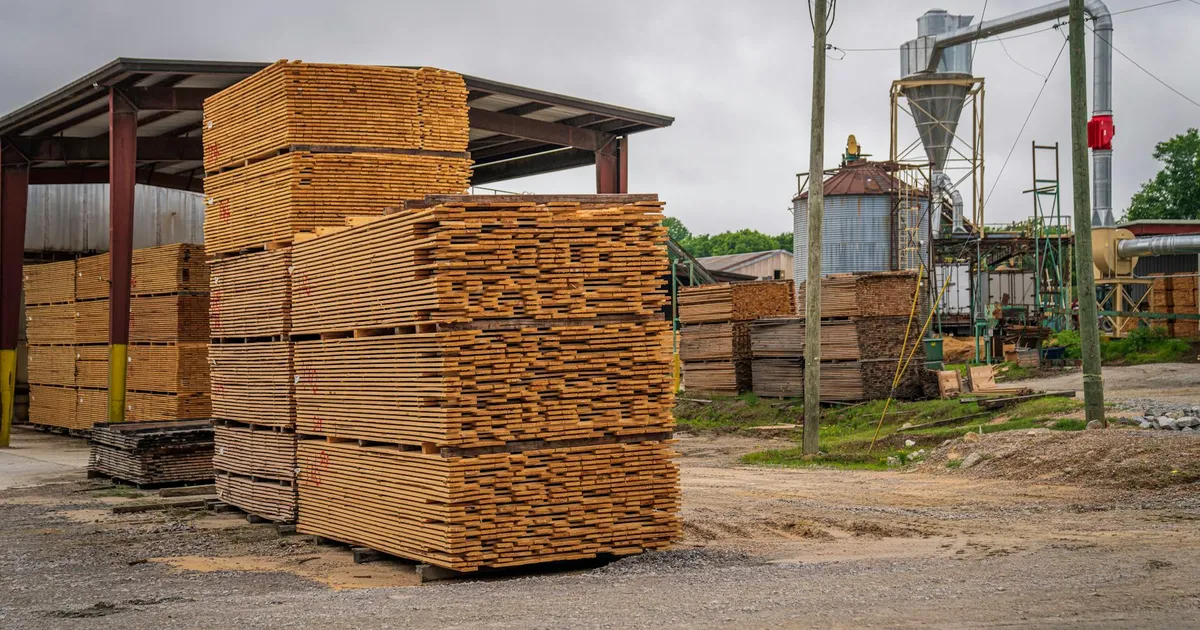
New Zealand has some of the world’s best softwood forestry resources, a construction sector that needs timber, and regional communities desperate for industrial employment. None of that has stopped Juken New Zealand from putting both its Kaitāia mills up for sale, citing power costs and weak export demand that have made the operations unsustainable.
The Northland Mill processes sawn timber. The Triboard Mill produces engineered wood panels for residential and commercial construction. Together they are the largest employer in a town with a population of around 6,000 and few other employment options. The mills consume roughly 30 percent of Kaitāia’s town water supply, a detail that illustrates just how physically embedded they are in the town’s infrastructure. If no buyer emerges within eight weeks, Kaitāia faces a cliff.
Juken has done this before
This is not the first time Juken has walked away from a regional New Zealand operation. In November 2023, the company closed its Te Tai Rāwhiti mill on the East Coast, putting 60 workers out of a job before Christmas. Managing director Hiroyuki Kawado said at the time the company “cannot continue with the ongoing losses” and had “not identified an alternative solution.”
The nearly 30-year-old East Coast plant had processed radiata pine for the Japanese housing market, where demand had been declining for five years. The language Juken is using about Kaitāia in 2025 is almost word-for-word identical to 2023. When a company repeats the same script, it is not a coincidence. It is a pattern.
The closures keep coming
Juken is not an outlier. Carter Holt Harvey is consulting on closing its Eves Valley sawmill in Nelson, which would eliminate 142 jobs. E tū union organiser Finn O’Dwyer-Cunliffe described workers as “absolutely gutted,” with some having just purchased homes now at risk.
Kinleith Mill in Tokoroa ran its final reel of paper on June 30, ending 70 years of manufacturing and costing more than 150 jobs. Oji Fibre Solutions cited untenable wholesale power costs. That closure followed a string of earlier paper mill shutdowns that had already cost 300 jobs nationally.
New Zealand Timber Industry Federation president Bruce Larsen has laid out the compounding pressures in detail: housing consents falling sharply, renovation activity subdued, compliance costs climbing, and toxic price competition forcing some sawmills to cut timber prices to unsustainable levels just to maintain cashflow. His warning is blunt: “When mills fail, local capacity disappears, along with jobs and regional economic activity.”
Tokoroa shows what happens next
Tokoroa’s trajectory is the long-run case study. A town built around a mill, its population has fallen from 20,000 at its 1970s peak to around 14,000 today. Kaitāia, with 6,000 people and fewer alternative employers than Tokoroa ever had, faces a steeper fall.
The damage extends well beyond direct employment. Logging and harvesting crews lose their primary customer. Freight operators lose anchor volume that makes regional routes viable. Local retail loses the spending power of hundreds of households. The housing market, already thin, loses a significant buyer cohort. And council faces a double hit: reduced rates revenue from the mill site and potentially stranded water infrastructure sized for industrial consumption.
The government picks winners, it just won’t admit it
Far North District Mayor Moko Tepania has called it “a bloody tough economic situation” and asked for central government involvement, pointing to the Regional Infrastructure Fund as a potential mechanism. But he is also making a sharper point. The government intervened significantly to support the Tiwai Point aluminium smelter with preferential electricity arrangements. It did not intervene to save Marsden Point refinery, also in Northland.
On what basis does the government decide which regional industrial employers are worth saving? If the answer is strategic national significance, then a smelter producing aluminium for export qualifies but a timber processor supplying New Zealand’s own construction sector does not. That is a difficult position to defend. If the answer is that government does not intervene, then Tiwai Point is the anomaly that needs explaining.
Far North power costs are among the highest in the country, a structural disadvantage that compounds every other pressure these mills face. Industrial electricity pricing is not a market outcome. It is a policy outcome. And right now, that policy is emptying out New Zealand’s manufacturing regions one mill at a time.
The MPI’s sector data and its December 2025 outlook report make clear these pressures are not cyclical. They are structural. Kaitāia’s eight-week clock is ticking, and the silence from Wellington is the loudest signal of all.
Sources
- RNZ: Kaitāia timber mills may close with loss of hundreds of jobs (2025-09-09)
- Wood Central: Juken NZ Lists Both Kaitāia Mills – Power Costs and Weak Exports Force Sale (2025-09-09)
- RNZ: Juken mill closure – Dozens of workers lose jobs as demand for pine products falls (2023-11-17)
- The Spinoff: Grist for the mill – the slow death of New Zealand’s industry towns (2025-12-31)
- Building Today: NZ timber manufacturing at a crossroads – Why strategic support is critical (2025-09-09)
- The Spinoff: How plant closures are pushing provincial towns to the brink (2025-08-25)
- Ministry for Primary Industries: Wood processing data
- Ministry for Primary Industries: Situation and Outlook for Primary Industries – December 2025 (2025-12)