

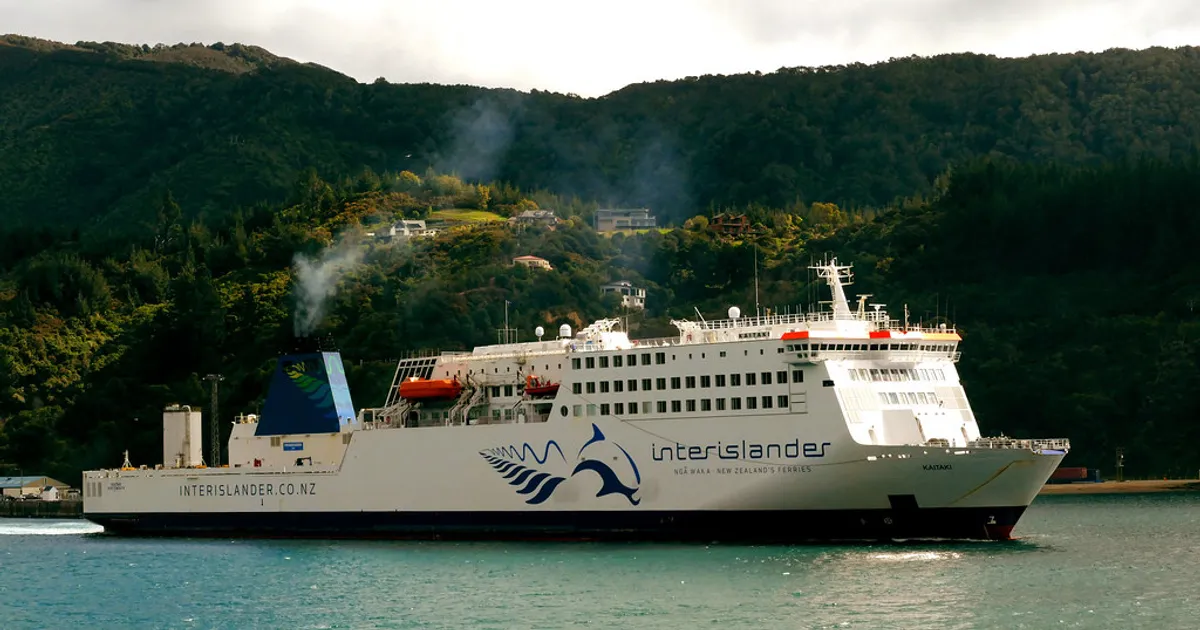
When the Interislander ferry Kaiārahi suffered a technical fault this month, reducing KiwiRail’s Cook Strait fleet to a single vessel for the first time in four years, the official response was familiar. Interislander general manager of operations Taru Sawhney called it “unfortunate”. A replacement part was ordered. Extra Kaitaki sailings were added. Normal service would resume shortly.
That framing is technically accurate and strategically misleading. This is not a one-off. It is the latest failure in a system running past its design limits with nothing in reserve.
The pattern nobody wants to call a pattern
By Wednesday 12 March, all Kaiārahi sailings had been cancelled through Sunday while a part was sourced, installed, tested, and approved by regulators. March is one of Interislander’s peak months, and capacity was described as “very limited.”
This was not even Kaiārahi’s first headline-making fault. In a separate incident, a steering problem during a Cook Strait crossing forced the vessel back to Wellington, stranding passengers for more than six hours with what they described as very little communication on board.
Rewind to June 2025 and the picture was worse. Maritime Union of New Zealand national secretary Carl Findlay told Scoop the entire Interislander fleet was simultaneously impaired: Aratere with engine shaft problems, Kaiārahi with bow door damage to be welded shut pending dry dock in Singapore, and Kaitaki pulled for a Maritime NZ audit. Findlay described the service as “hanging by a thread”.
The ferries that should be here aren’t coming until 2029
The iRex programme would have delivered purpose-built replacement ferries entering service around now. Finance Minister Nicola Willis cancelled it as a cost blowout. The decision was presented as fiscal responsibility. What it actually produced was a three-year gap.
KiwiRail retired the Aratere, the fleet’s only rail-enabled vessel, in August 2025, along with 70 job cuts for Maritime Union members. New ferries announced by Minister of Rail Winston Peters are not expected until at least 2029. In the interim, an ageing two-vessel Interislander operation plus Bluebridge’s private service must carry a freight corridor worth approximately $30 billion a year.
Transporting New Zealand CEO Dom Kalasih described Cook Strait as “an essential extension of State Highway 1” and warned that businesses are already reporting pressure on freight capacity during peak periods, before the next scheduled maintenance crunch even begins.
Winter is the real test
The Maritime Union’s Findlay has warned of a “winter of discontent”. Between late June and late September 2026, Kaiārahi will undergo a scheduled lay-by and Kaitaki will enter dry dock, meaning Interislander will operate on a one-ship timetable at times. “New Zealand is one breakdown away from a transport crisis,” Findlay said.
The road freight industry agrees. The 2025 National Road Freight Survey found 79 per cent of respondents agreed or strongly agreed that ferry replacement delays represent a significant threat to both the freight sector and the wider economy. Transporting New Zealand policy lead Billy Clemens put it simply: “The significance of the link between the North and South Islands cannot be overstated.”
Kalasih flagged the dry dock risk directly: “When ferries are out of service during wet and dry dock periods, the fleet can be reduced to two or three vessels for months at a time.”
The port makes everything worse
Vessel age is only half the problem. Stephen Grice, managing director of Clifford Bay Port Limited, identified Picton’s port layout as a structural constraint that amplifies every disruption: “The antiquated system does not have any resilience. With ferries at maximum capacity, there is no ability to recover from disruption.”
Grice described the Picton model as “trying to force modern volumes through a 20th-century bottleneck”, with inefficient marshalling and complex Tory Channel navigation adding hours to every sailing. When a vessel goes down, there is no slack in the system to absorb the backlog.
Meanwhile, the government cut the emergency tug MMA Vision contract months ahead of schedule to save money, removing a safety backstop. Findlay called it “a sign of dangerous complacency regarding maritime safety and reliability.”
Fiscal discipline that costs more than it saves
The government is not uninformed. A Ministerial Advisory Group reported to Treasury on Cook Strait vulnerabilities. An OIA request to Minister Peters sought detailed freight volume and utilisation data. The data exists. The awareness exists. What does not exist is urgency.
Cancelling iRex saved money on the balance sheet. But every cancelled sailing, every rerouted truck, every South Island exporter waiting for capacity that is not there represents a cost that does not show up in Treasury’s books. For freight operators and the businesses that depend on them, the question is no longer whether Cook Strait will fail during the single-vessel winter window. It is what happens to $30 billion worth of annual freight when it does.
Sources
- NZ Herald: Interislander fleet reduced to one after Kaiārahi technical fault (2026-03-09)
- 1News: Cook Strait ferry out of action with fault (2026-03-12)
- RNZ: Passengers stuck on Interislander ferry Kaiārahi after steering problems
- Scoop/Maritime Union: Concerns about ongoing Cook Strait ferry issues (2025-06)
- Scoop/Transporting New Zealand: Ferry update answers road freight sector’s burning questions (2026-02-27)
- Scoop: Winter of discontent – ongoing ferry failures highlight urgent need for emergency response vessel (2026-03)
- TransportTalk: Delays to Cook Strait ferries pose major risk to freight sector – survey (2025)
- North South Express: Ferry chaos – stranded families and overbooked ships prove the patch-up approach won’t work
- FYI.org.nz: Cook Strait ferry freight OIA request to Winston Peters (2025-01)