

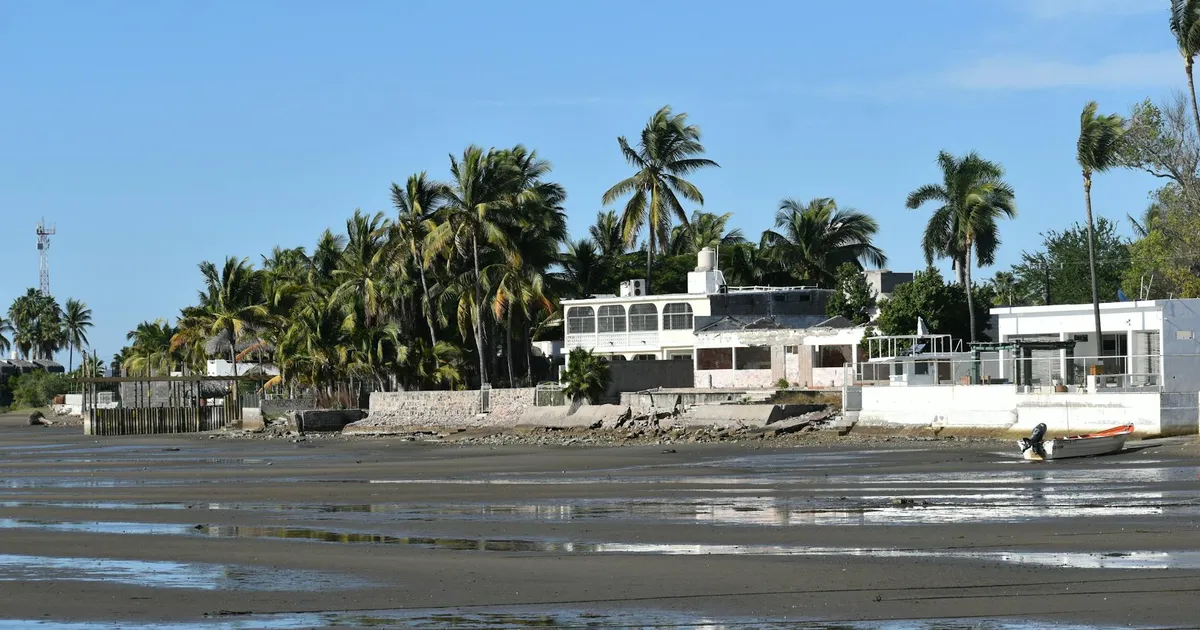
Amberley Beach, population not much, is one of the most organised coastal communities in New Zealand when it comes to planning for the ocean’s advance. Hurunui District Council spent three years developing a coastal adaptation plan with trigger-based escalation from bund maintenance to managed retreat. Of 109 property owners consulted, 37 gave feedback on land banking for retreat, and most were in favour. It is a thoughtful, locally driven model.
It also has no legislative backing, no national framework to plug into, and no certainty about who actually carries the loss when the triggers fire. Amberley Beach is not the problem. Amberley Beach is the preview.
The four-page framework that says nothing
The Government’s National Adaptation Framework, released in late 2025, was supposed to answer the question councils have been asking for years. It runs to four pages. Its core principle is that costs from natural hazards should be “shared across society and over time”, which is a sentence that could mean anything and currently means nothing.
National promised on the 2023 campaign trail to deliver certainty for property owners and ensure support would be predictable, principled, and fair. The framework delivers none of those things. It does not clarify the respective roles of central government, local government, insurers, or property owners. The most substantive work, an Expert Working Group report chaired by retired Supreme Court Justice Sir Terence Arnold, sits before a parliamentary committee. It has not produced legislation.
Meanwhile, 219,000 homes worth a collective $190 billion sit in coastal and inland flood zones. A Ministry for the Environment report estimates the number expected to experience at least one damaging flood event between 2026 and 2060. The empirical foundation exists. The liability framework does not.
Insurance is not waiting for politicians
Peer-reviewed research published in Climatic Change journal finds that 99% of properties in 1% Annual Exceedance Probability coastal inundation zones can expect at least partial insurance retreat within a decade with less than 10 centimetres of sea level rise. Full insurance retreat is predicted within 20 to 25 years.
This is not a modelling curiosity. It is a credit risk event. Banks require insurance as a condition of mortgage lending. When insurance retreats from a zone, mortgaged properties become uninsurable, unsellable, and worthless as collateral. Property Council NZ notes that councils are already applying “cessation of habitable use” consent conditions tied to managed retreat triggers. The legal devaluation of these properties is already underway through the resource consent system, quietly, without a national conversation about compensation.
Auckland showed what retreat costs and proved nothing is replicable
The largest practical precedent is Auckland’s post-2023 storm programme. Auckland Council agreed in principle to a $2 billion cost-sharing package with central government, including $774 million for buyout of roughly 700 Category 3 homes. That deal required council borrowing and future rate rises. It was also a one-off negotiation between New Zealand’s largest city and central government, not a template smaller councils can replicate.
Waimakariri District Council CEO Jeff Millward asks the obvious question: “Does it fall back on the ratepayer or the taxpayer? It is a bit more complicated and a lot more discussion has to happen.” Kaikōura District Council CEO Will Doughty is blunter: “One thing is for sure, there is going to be a bill.”
River communities get protection while coastal ones get nothing
The political inequity is sharpest in Hawke’s Bay. More than $250 million is being spent to protect inland communities from river flooding following Cyclone Gabrielle. Coastal communities like Haumoana, losing half a metre of beachfront annually, have no responsible governing body and no protection investment. Hastings District Council has spent just $1.9 million over five years on coastal erosion prevention.
Ann Redstone, a former Hastings District Councillor who founded the Walking on Water charitable trust in 2009, captures the frustration: “That was 17 years ago. Yet here we are having the same discussion.”
Disaster inertia is the real policy
RNZ analysis by researchers Benjamin Tombs, Judy Lawrence, and Rob Bell identifies the pattern plainly: post-disaster reviews over the past decade repeatedly identify the same problems, some dating back to 1986, without meaningful reform. They call it “disaster inertia.” Engineered protection like seawalls crowds out land-use planning and creates levee effects that encourage more development behind barriers, increasing future liability.
Professor Jonathan Boston of Victoria University has done the most systematic work on compensation. His conclusion satisfies nobody: “Taxpayers shouldn’t have to fully compensate multi-millionaires for the loss of their coastal mansions”, but equally, “without public support, some owners risk losing their life’s savings”.
The uncomfortable truth for anyone with exposure to New Zealand property, whether as an owner, lender, insurer, or ratepayer, is that the absence of a framework is itself a policy choice. Every year without legislation is another year of development in flood zones, another year of mortgage books building exposure to uninsurable assets, and another year closer to the insurance retreat the research says is coming within a decade. The bill is accumulating. The only question is whether it lands as planned cost-sharing or as a series of financial crises, one storm at a time.
Sources
- RNZ: Managed retreat an option in council plan for North Canterbury beach settlement
- Newsroom: Long-awaited climate adaptation plan leaves ‘who pays’ unanswered
- Ministry for the Environment: Report of the Expert Working Group on Managed Retreat
- Ministry for the Environment: Estimated number and valuation of residential properties within inundation/flood zones
- Climatic Change: Insurance retreat in residential properties from future sea level rise in Aotearoa New Zealand
- Property Council NZ: Opinion – What is natural hazard residual risk
- NZ Herald: Auckland councillors agree in principle to $2 billion flood buyout deal
- ODT: Who will pay to protect communities from flooding
- RNZ: $250m snub – Beachfront homeowners call for flooding protection ‘fair go’
- RNZ: Disaster inertia – why must NZ keep relearning the same lessons from extreme events
- Newsroom: The urgency of funding managed retreat
- Environmental Defence Society: Funding Managed Retreat – Designing a Public Compensation Scheme